New Delhi: Pakistan’s Legal Maneuvers Over Indus Waters Treaty
Pakistan, seeking legal action over India’s move to place the Indus Waters Treaty in "abeyance," is planning to take India to international court. This desperate attempt aims to find some reprieve amidst the ongoing water crisis.
The agreement between the two neighboring countries, signed in 1960, has endured through three wars fought in 1965, 1971, and 1999. However, Pakistan is now ready to run pillar to post to find a solution, bringing much respite to tens of millions of its citizens.
Pakistan’s Minister of State for Law and Justice, Aqeel Malik, told Reuters that Islamabad is working on plans for at least three different legal options, including raising the issue at the World Bank, the treaty’s facilitator.
Islamabad is also considering taking action at the Permanent Court of Arbitration or at the International Court of Justice in the Hague, where it could allege that India has violated the 1969 Vienna Convention on the Law of Treaties.
Mr. Malik further stated that a fourth diplomatic option that Islamabad was considering was to raise the issue at the United Nations Security Council.
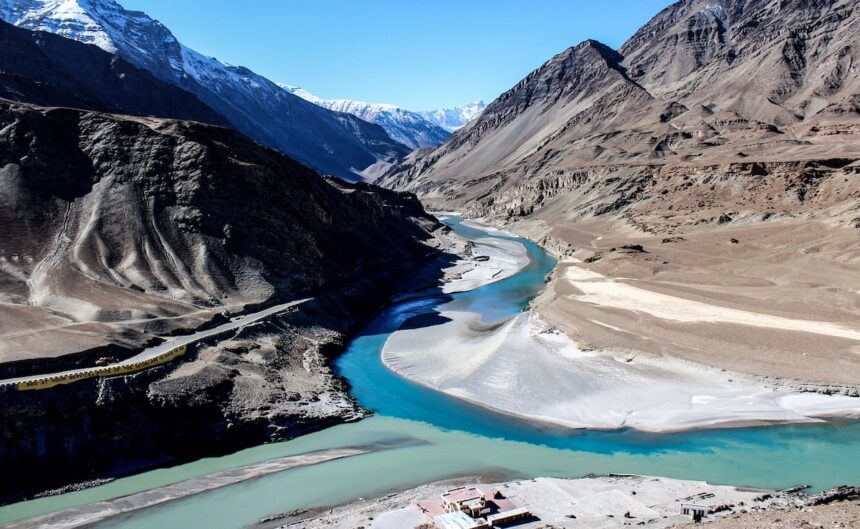
The Indus Waters Treaty essentially states that the distribution and use of waters from the Indus River and its tributaries – the Sutlej, Beas, Ravi, Chenab, and Jhelum – would be shared by India and Pakistan. India, being the upper riparian state, technically has rights to the waters of all six rivers, but the agreement allowed Pakistan to get the full flow of waters of the Chenab, Jhelum, and Indus.
Mr. Malik blamed India for ending the Indus Waters Treaty unilaterally, saying that "The treaty cannot be ended unilaterally," adding that "there is no such provision within the treaty."
However, Pakistan’s recourse will likely not bear fruit. Here is a look at why:
Why International Court of Justice Cannot Arbitrate
The jurisdiction of the ICJ is based entirely on the consent of States (nations) and not on a universal obligation. States need to declare its acceptance in full or in part, or through declarations of compulsory jurisdiction.
On September 27, 2019, India, which abides by the international rules-based order, has also submitted a declaration recognizing the jurisdiction of the Court as "compulsory." However, in the declaration signed by Dr. S Jaishankar, India had listed down 13 exceptions wherein ICJ shall not have jurisdiction over India.
Out of the 13 points, point number two reads, ICJ shall not have jurisdiction for "disputes with the government of any State which is or has been a Member of the Commonwealth of Nations." This means that Pakistan, which is a Commonwealth nation, cannot take India to the ICJ, since its jurisdiction is not valid in the case, thereby making any such attempt by Islamabad null and void.
Similarly, point number five of the same declaration states that ICJ shall not have any jurisdiction in "disputes relating to or connected with facts or situations of hostilities, armed conflicts, individual or collective actions taken in self-defense, resistance to aggression, fulfillment of obligations imposed by international bodies, and other similar or related acts, measures or situations in which India is, has been or may in future be involved, including the measures taken for protection of national security and ensuring national defense."
For the Permanent Court of Arbitration, a similar consent applies, thereby ruling it out entirely.
Why World Bank Cannot Intervene
The World Bank also does not have any jurisdiction over the Indus Waters Treaty besides playing the limited role of a mediator or adviser to both parties in the treaty. The World Bank is not a keeper of the treaty, and can only encourage dialogue in times of a disagreement.
In 1960 too, the World Bank had only brokered the Indus Waters Treaty between India and Pakistan as a mediator.
While the global financial body facilitates appointments of neutral experts and chairs of courts of arbitration, it is limited to the role of an appointer of such posts and cannot be responsible for the treaty’s overall management or its enforcement.
Indeed, the World Bank can facilitate a dispute resolution mechanism, but only in the capacity of a neutral adviser, with its non-binding suggestions and recommendations being possibly rejected. Hence the global body cannot be considered a guarantor of the treaty. It can neither enforce it, nor unilaterally determine its interpretation.
Conclusion
Pakistan’s legal maneuvers over the Indus Waters Treaty are futile, as the International Court of Justice and the World Bank do not have the jurisdiction to arbitrate or intervene in the matter. The treaty’s terms and the consent of the parties involved make it clear that Pakistan cannot take India to the ICJ or the World Bank.
Reference : https://www.ndtv.com/world-news/pakistans-4-point-plan-over-indus-waters-treaty-and-why-they-wont-work-8289297#publisher=newsstand