India Halts Chenab River Flow via Dam Closures, Demonstrates Strategic Water Control Amid Treaty Suspension
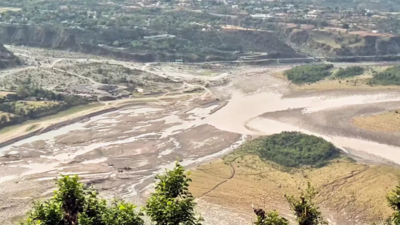
Srinagar/Jammu | The Prime News Network: In a strategic move underscoring India’s water management capabilities, authorities have restricted water discharge from Jammu’s Baglihar and Salal hydroelectric dams on the Chenab River, causing unprecedentedly low water levels. Residents in downstream areas recently walked across the river bed—a phenomenon unseen in decades.
This action follows the Indian government’s suspension of the Indus Water Treaty (IWT) with Pakistan after the April 22 Pahalgam terror attack, which claimed 26 lives. Under normal circumstances, the treaty requires India to notify Pakistan before regulating Chenab flows.
Dams Closed, Water Flow Ceased
Government sources confirmed the closure of all five main gates at both Baglihar Dam and Salal Dam, effectively halting the Chenab’s downstream flow. The river, critical for Pakistan’s Punjab province, saw water levels drop to 1.5-2 feet from 25-30 feet in parts of Jammu’s Akhnoor region, enabling locals to traverse its bed.
“For the first time in my life, I walked halfway across the Chenab. It’s unbelievable,” said an Akhnoor resident on Monday. Children collected coins from exposed riverbeds, while others celebrated the move as a geopolitical statement.
Public Support for Treaty Suspension
Local sentiment overwhelmingly backs Prime Minister Narendra Modi’s decision to suspend the IWT. “We don’t want a single drop of water going to Pakistan. We stand with the Indian Army and PM Modi,” stated Akhnoor resident Vinay Gupta. Kamal Langer echoed this, calling the move a “befitting reply” to Pakistan.
Strategic Implications Acknowledged
Luv Puri, former UN counter-terrorism official and Kashmir expert, noted the suspension’s far-reaching consequences. “This action reflects significant prior preparation. Earlier assumptions about India’s lack of infrastructure to leverage water as a strategic tool have proven incorrect,” Puri emphasized, highlighting India’s enhanced water management infrastructure.
The 1960 IWT grants India rights over the Sutlej, Beas, and Ravi rivers, while Pakistan controls the Chenab, Jhelum, and Indus. Critics, including Jammu & Kashmir National Conference leaders, argue the treaty disproportionately harms regional interests. Former Chief Minister Farooq Abdullah reiterated calls to review the agreement, advocating for Chenab water diversion to Jammu and Jhelum-based power generation in Kashmir.
As India asserts greater control over transboundary water resources, the Chenab’s temporary drying marks a pivotal moment in South Asian hydro-politics, signaling shifting dynamics in regional water diplomacy.