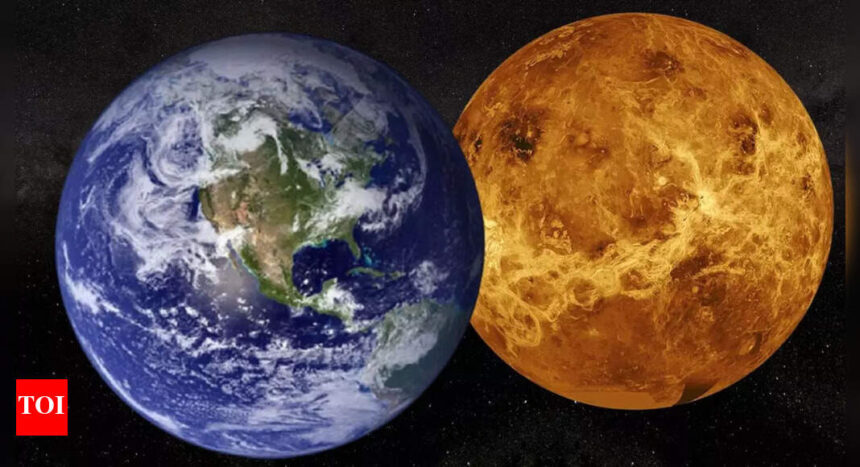
NASA Reveals Venus Is Geologically Active
In a groundbreaking discovery, NASA researchers have unveiled data suggesting that Venus, long thought to be a barren, hot desert planet, might actually be geologically active. This new finding overturns long-standing theories about the planet’s surface and its inactivity with respect to tectonic motion.
Using advanced modeling techniques, scientists re-examined decades-old radar data to discover signs of tectonic activity on Venus, indicating an active planet. This find not only revises our understanding of Venus but also offers fresh perspectives on planetary evolution and habitability.
Tectonic Activity on Venus’ Surface
For decades, Venus was believed to have a solid, immobile crust without any internal activity. However, NASA researchers have turned that idea on its head with new research. The study suggests that the surface of Venus could actually be re-molding itself, similar to how Earth’s crust is re-molded through tectonic activity.
The findings result from careful re-examination of radar images captured by NASA’s Magellan spacecraft in the 1990s. By utilizing advanced computer modeling techniques and enhanced image analysis programs, scientists compared Venus’ ancient surface characteristics and discovered surprising signs of movement.
The pictures revealed that parts of Venus’ surface appear to be fragmented into enormous crustal blocks. These blocks shift and rotate relative to each other, similar to how ice floes drift on the ocean. This floating indicates a mobile crust and suggests mantle convection beneath, indicating that Venus retains internal heat and is dynamically active to this day.
What is ‘Flake Tectonics’?
As opposed to Earth, with its gigantic, stiff tectonic plates, Venus may experience what scientists call "flake tectonics." Here, the crust is composed of weaker, smaller pieces, reminiscent of flakes on a soft, churning mantle. Driven by internal heat, the flakes slowly move and reprocess the surface over time.
Though this process differs from Earth’s plate tectonics, it still implies that Venus does have a geologically active interior. Lead study author Paul Byrne emphasizes, "This tells us that Venus is not a dead planet. It’s actually doing things."
Insights into Earth’s Habitability
Earth’s tectonic activity is implicated in governing the climate of the planet and recycling essential elements through volcanic and subduction processes. Venus, hitherto, was thought to have no such internal movement that accounts for its very harsh surface conditions. The finding of movement on Venus changes that narrative. It suggests that Venus may be more geologically active than previously believed and may help scientists understand why Earth became a habitable planet and Venus did not.
Insights into Venus’ Geology and Earth’s Future
This discovery was made not with new spacecraft, but by re-analyzing decades of radar data with sophisticated computer modeling techniques. Improved image processing allowed scientists to detect features that had gone undetected for decades. These findings follow in the wake of NASA developing two major missions to Venus: VERITAS (Venus Emissivity, Radio Science, InSAR, Topography, and Spectroscopy) and DAVINCI (Deep Atmosphere Venus Investigation of Noble gases, Chemistry, and Imaging). These missions will launch sometime in the near future and aim at bringing to us the complete understanding of the planet’s geology and atmosphere.
Understanding the dynamic development of Venus not only expands our understanding of this neighbor planet but also offers valuable context for gaining insight into the history of Earth. Researchers hope that this research will:
- Broaden the understanding of how the rocky planets develop and change over time.
- Enlighten us as to why Venus, although the same size and composition as Earth, developed so differently.
- Offer predictive insight into Earth’s future geological fate over extended time frames.
- The discovery of a mobile crust on Venus raises basic questions regarding the functioning of terrestrial planets and might change the way we search for life and habitability in the rest of the universe.
Also Read
World’s largest telescope rises in Chile, set to unlock the mysteries of the cosmos