Energy Deficiency Impacts Collegiate Running Performance
Collegiate female endurance runners who experience chronic energy deficiency throughout a competitive season may compromise their performance and training benefits, according to a recent study by researchers in the Penn State Department of Kinesiology.
The team published their findings in the European Journal of Sport Science, demonstrating that runners who do not consume enough calories during their preseason had slower race times than their counterparts during the season.
Co-author Nancy Williams, professor of kinesiology and physiology, said, "This is the first study to employ objective, laboratory-based health measurements to predict performance."
Individuals who do not eat enough food to meet their energy needs experience energy deficiency, which may cause fatigue, increased risk of injuries, and decreased athletic performance. Chronic energy deficiency occurs when an individual has a recurring, insufficient energy intake to match their caloric expenditure. For women, energy deficiency can lead to menstrual irregularities and impaired bone health, a condition known as the female athlete triad.
According to prior research from Williams and Mary Jane De Souza, endurance sports like running—where leanness is considered advantageous for performance—increased the risk for developing chronic energy deficiency.
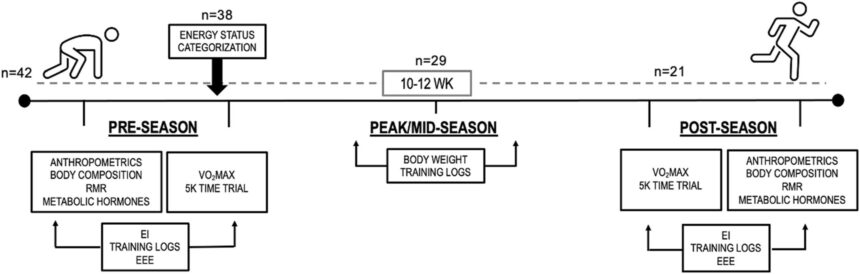
The research team held an outdoor 5K race with 21 collegiate female endurance runners in the weeks before their competitive season, known as preseason, and the weeks after their competitive season, called post-season. Three factors were assessed in the study—energy status, body composition, and 5K time trial results.
The researchers found that two independent, objective measures of energy deficiency—resting metabolic rate (RMR) ratio and circulating thyroid hormone (TT3)—were predictive of running performance. RMR ratio compares actual-to-predicted resting metabolic rate and is a laboratory-validated measure of chronic energy deficiency.
According to Williams, TT3 is assessed with blood tests and is considered an objective measurement for energy deficiency due to the hormone’s influence on whole body metabolism.
The endurance runners were categorized as either having sufficient or insufficient energy intake based on their preseason assessment of energy status. Those with a measured RMR less than 92% of their predicted RMR were metabolically suppressed, meaning they had insufficient energy intake; those with a measured RMR equal to or greater than 92% of their predicted RMR were non-metabolically suppressed, meaning they had sufficient energy intake.
The researchers found that female endurance runners categorized as energy insufficient in the preseason exhibited slower racing times and running velocity during the 5K time trial than runners categorized as energy sufficient in the preseason.
Williams said linking energy status to performance may motivate endurance runners more than linking energy status to factors like menstrual health. "Athletes are naturally competitive and motivated by success, even if that success costs them their long-term health," she said. "But maintaining proper energy status benefits their performance during the sports season and likely their long-term health."
Energy deficiency can also be associated with a loss of training benefits—like slower injury recovery or poorer bone health—in energy insufficient runners. But Williams said hope isn’t lost for energy-deficient runners. "Energy status is reversible," she said. "The nice thing about uncovering whether the body is energy deficient is that athletes can implement strategies like increasing calories to improve energy status and training benefits."
Williams said uncovering any predictor of performance—in this case, energy status measured by RMR ratio and TT3—is especially important for athletic coaches. "These are measurements coaches could use if only they could access and know about them," she said. "It’s hard for coaches to use laboratory-validated measures or procedures that require blood tests."
Lead author and former collegiate coach Emily Lundstrom agreed. Lundstrom, who earned her doctorate in kinesiology from Penn State in 2024 and is currently an assistant professor of biokinesiology and physical therapy and sport scientist at the University of Southern California, said coaches must be mindful of how nutrition can support athletes’ performance and long-term health.
"As a coach, you can play a crucial role in athletes’ nutritional education by explaining how under-fueling compromises overall health, muscle recovery, and training adaptations, which may lead to reduced performance across a season," Lundstrom said.
Lundstrom added that frequent use of nutrition or fueling stations during training sessions can support healthy eating habits while preserving health and performance if such tools are accessible for teams.
Williams said the next step of this research is to determine whether objective RMR ratio and TT3 measurements can be simplified and put into the hands of coaches and athletes to predict—and eventually enhance—athletic performance.
More Information
- Citation: Energy deficiency impacts collegiate running performance (2025, May 1)
- Retrieved 1 May 2025
- From https://medicalxpress.com/news/2025-05-energy-deficiency-impacts-collegiate.html
This document is subject to copyright. Apart from any fair dealing for the purpose of private study or research, no part may be reproduced without the written permission. The content is provided for information purposes only.
Reference : https://medicalxpress.com/news/2025-05-energy-deficiency-impacts-collegiate.html