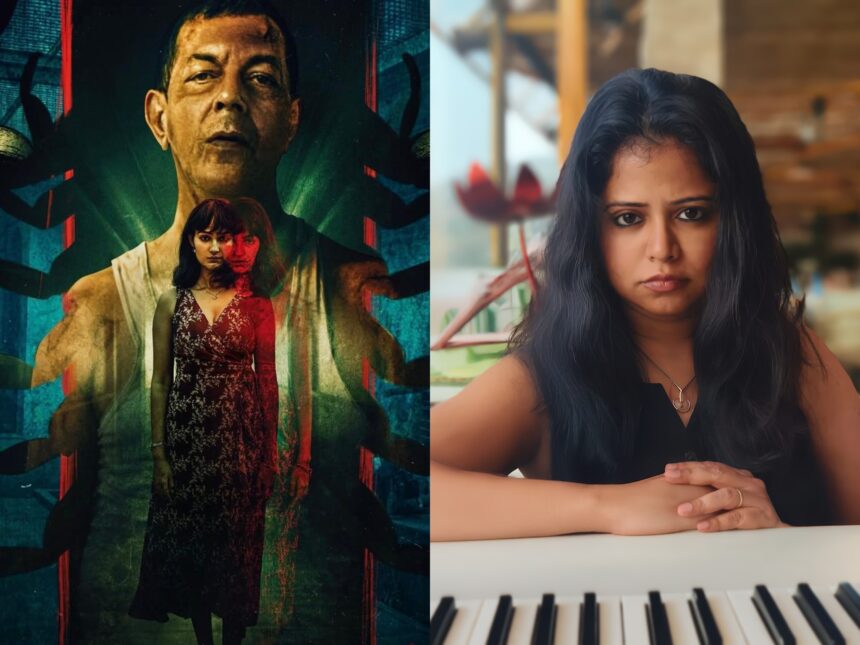
Music Composer Alokananda Dasgupta Creates the Soundtrack for Prime Video’s ‘Khauf’
Growing up in Kolkata, music composer Alokananda Dasgupta was introduced to horror through Bengali literature rather than films. "I couldn’t read English at the time," she recalls, "so I had to lose myself in fantasy stories to understand life as a child."
For the 1980s-born artist, the horror genre offered a kind of "beautiful escapism"—a way to safely explore fear. The Bengali stories she gravitated toward weren’t typical haunted house tales, like Goosebumps. Instead, they were set in daytime hostel environments, turning scorching summer afternoons in Kolkata into something quietly unsettling.
When she read Smita Singh’s script for "Khauf," the Prime Video horror anthology released last month, she was reminded of things she’d read. "I haven’t come across too much of that category coming from India. So this was something new," she says. Dasgupta, known for her work on shows like "Sacred Games" and thrillers such as "Trapped," joined "Khauf" as composer for the directorial debut of cinematographer and writer Pankaj Kumar, who is best known for his work on "Ship of Theseus," "Haider," and "Tumbbad."
The reception to "Khauf" has been encouraging, she says. "It’s a very good reminder to everyone that there is a section of the audience that you have to cater to," she adds. "You can’t just brush them off as niche." At a time when Bollywood’s comedy-horrors have been making a dent at the box office, "Khauf" pairs psychological and supernatural elements with a dose of important social commentary.
As an avid fan of the genre, Dasgupta believes Indian cinema has rarely managed to do horror right. For that to change, she says, there needs to be deeper attention to the technical aspects of filmmaking, particularly mise en scène and design. "I’m not talking about just it being top-notch in terms of money," she clarifies. "I’m talking about top-notch in terms of attention to these details."
On "Khauf," it was the visual storytelling that drew her in. "Every frame is like a painting, so it creates a certain world," she says. "I’m a huge fan of the horror genre, but not particularly the other kinds, which are in-your-face and have too many jump scares." The score, now streaming on major platforms, enhances the tension and haunting mood of the series, often leaning into subtlety. The opening title track, "Dread Of The Night," layers guitars with a hair-raising violin, clarinet, and more to set the tone.
In preparation, Dasgupta immersed herself in a wide spectrum of horror film scores—from "It Follows" to 2022’s "All Quiet on the Western Front" and even the recent "Nosferatu." These works, she says, "created that atmosphere of sheer dread." She also references "Rosemary’s Baby," "The Wicker Man," the original 2003 Danish film "Midsommer," and the music of "The White Lotus"—a playlist of sorts that she and the creators of "Khauf" exchanged to understand the emotional and cinematic universe they were building.
With that foundation, her mission was clear. "I was looking to create intrigue," Dasgupta says. She connected deeply with Madhu, the character played by Monika Panwar, and felt compelled to contribute her own voice to the story—not just as a composer, but as someone with something personal to express through horror music. Her aim was to find the right balance between melodic, ambient, and atmospheric sound.
"My instruments chose themselves," she says. The score features a mix of bass clarinet, low brass, and prepared cello, each contributing distinct textures. Chennai-based violinist Vignesh brought further depth, experimenting with thumping and scraping the instrument’s body to produce eerie effects. The original score also includes contributions from composers Aditya N. and Himanshu Prakash, with mastering by Keshav Dhar. One standout motif features a flute, inspired by a clinic in the series named Ruhani Dawakhana, or spiritual pharmacy. "It was very inspiring to me," she says. "It was a very beautiful and poetic name that took me back to reading those [Bengali horror] stories."
While horror still struggles to find a consistent audience in India, Dasgupta notes that horror music—especially ambient, minimalist scores—faces an even steeper climb. Yet she remains hopeful. "Let it be released, even if it’s an ambient, understated score. Let it be out there," she says, with quiet conviction.
Watch "Khauf" on Prime Video.