Headline: A Young Traveller, an Able Administrator
Christian Goldbach, born in 1690 in Konigsberg (now Kaliningrad, Russia), was the son of a pastor and grew up in the city and studied there. Despite his initial focus on law and medicine, he eventually turned his attention to mathematics and law.
By his teens, he began his extensive travels, meeting leading scientists as he went. Upon his return, he established himself as an accomplished mathematician, becoming a professor of mathematics and historian at the newly established Saint Petersburg Academy of Sciences.
When Peter II became the Tsar in 1728, Goldbach was appointed as a tutor to the young Prince Peter. He continued his administrative work after the court moved from St. Petersburg to Moscow, becoming a prominent figure in both science and politics.
Despite political changes, Goldbach remained committed, influencing the education of royal children and serving as a senior diplomat in the Ministry of Foreign Affairs. He died in Moscow in 1764 at the age of 74.
Keeping in Touch
Goldbach’s correspondence spanned over his life, including not just scientific discussions but also personal and professional relationships. He corresponded with outstanding mathematicians like Gottfried Leibniz and Abraham de Moivre, as well as the Bernoullis, friends from the mathematical community.
His most famous correspondence was with Leonhard Euler, who met him in 1727 in St. Petersburg. Their relationship lasted until Euler’s death in 1783, covering 35 years and covering topics from calculus to number theory. For Euler’s curiosity, it sparked his interest in number theory, and Goldbach was even the godfather of Euler’s daughter.
Goldbach’s Conjecture
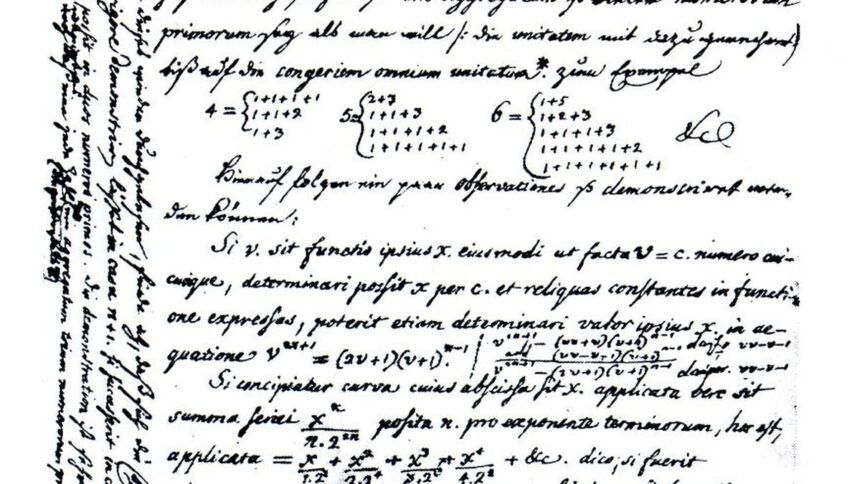
One of the most famous parts of their correspondence was the formulation of Goldbach’s Conjecture: "Every integer greater than 2 can be expressed as the sum of at least three primes." This statement is now known as the version saying that every even integer greater than 4 can be expressed as the sum of two primes.
Despite being proven true for nearly 300 years, the conjecture remains one of the oldest unsolved problems in mathematics, with many worlds trying to crack it.